The Application Landscape for Ultra-Low Temperature Refrigeration: Which Applications Actually Need the -60℃ Class
Maps the demand landscape for -60℃ class low-temperature refrigeration by engineering characteristics rather than by industry list, discusses how the temperature-band divide arises and how heat load and ambient conditions affect selection, sets out the qualitative basis for judging demand-side shifts, and identifies the three constraints most often overlooked.
The conclusion in one sentence
-60℃ is not a label for "a bit colder" but the point at which low-temperature refrigeration changes gear in the way it is implemented. Entering this band, a single-stage cycle on a single pure refrigerant effectively fails: dephlegmation separation of a zeotropic mixture has to be introduced, or the circuit has to move to a cascade two-stage arrangement, and the machine's sensitive variables, commissioning targets and maintenance items all shift up as a whole. Whether an application needs the -60℃ class therefore cannot be judged from the target temperature written in the process document alone; it depends on whether four things — the shape of the heat load, the timing requirements for pull-down and warm-up, the ambient conditions, and the operating and maintenance capability — match the characteristics of a machine in this band. Force the -60℃ class onto an application that does not need it and the price is lifecycle-wide complexity; carry -40℃ class selection thinking into an application that genuinely belongs in this band and the problems surface late in commissioning or after the first major overhaul, not on acceptance day.
Scope of discussion
- This article discusses the demand-side characteristics and selection judgement for -60℃ evaporating temperature class low-temperature refrigeration; it does not discuss the performance figures of specific models.
- Machine performance figures (cooling capacity, COP, pull-down rate, noise and so on) are given throughout as placeholders (of the form
{{制冷量}}) and must be taken from measurement under the specific operating conditions or from the accompanying technical documentation. - No cross-comparison of manufacturers, brands or products is involved; only the match between technical route and engineering conditions is discussed.
- No market size, share, growth rate or price data is given; where an industry judgement is involved, only a qualitative statement and its basis are given.
- The reference platform is a -60℃ evaporating temperature class single-stage auto-cascade (SACR) low-temperature refrigeration unit, capacity range 1 – 50 kW (planned family range, not measured values of any single model).
- Cycle mechanism, component selection and commissioning detail are not developed here; see Single-Stage Auto-Cascade (SACR) Cycle Overview.
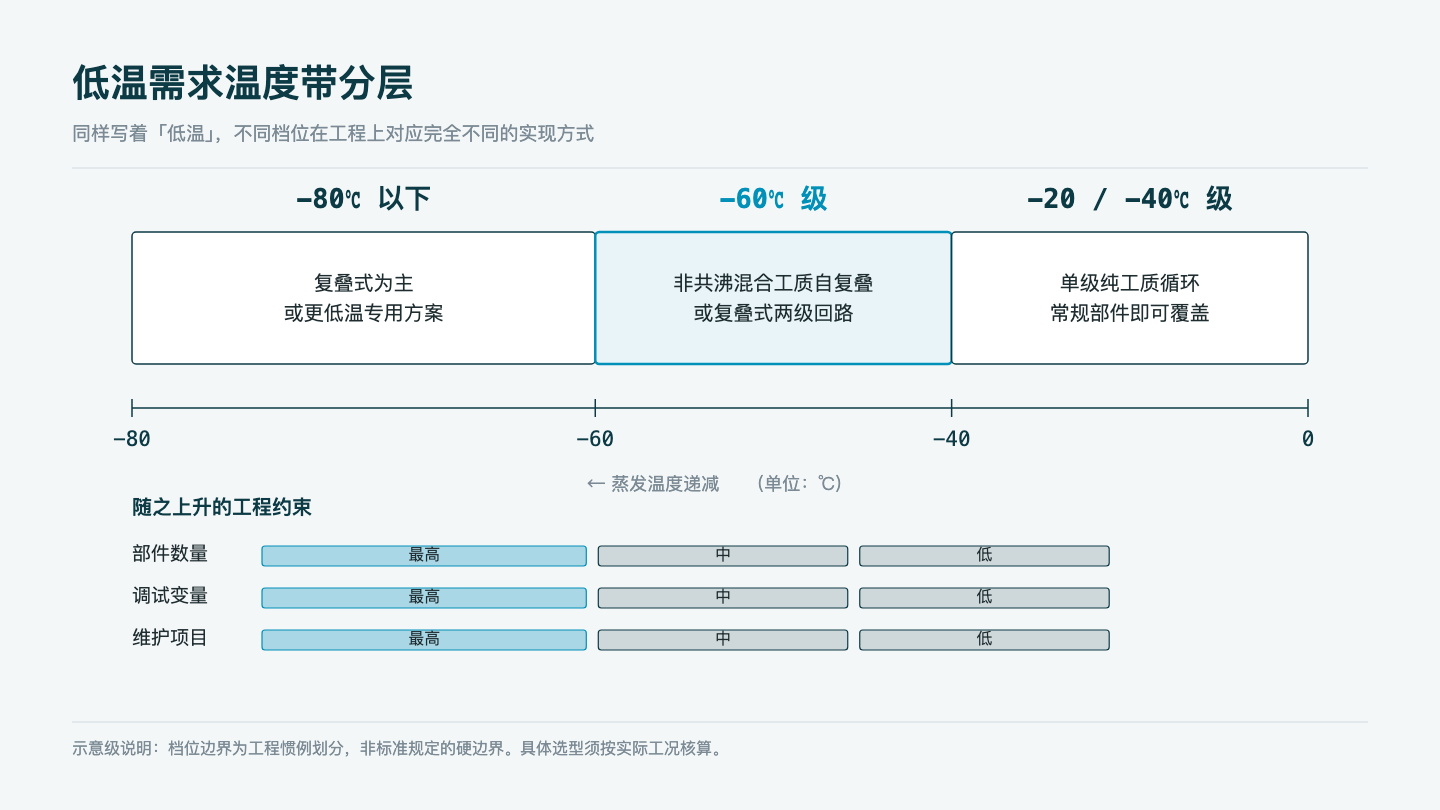
1. Temperature banding: how the -60℃ divide arises
Splitting low-temperature demand by temperature band explains the situation better than listing it by industry. Although all of it is written as "low temperature", the different bands correspond to fundamentally different implementations in engineering — not one set of equipment with a different setpoint.
| Temperature band | Main implementation | Key limitation | Step up in engineering cost |
|---|---|---|---|
| -20 / -40℃ class | single-stage cycle on a pure refrigerant, coverable with conventional components | pressure ratio and discharge temperature still inside the envelope of a conventional compressor | close to ordinary industrial refrigeration units, few maintenance items |
| -60℃ class | zeotropic mixed refrigerant + dephlegmation separation (auto-cascade), or a cascade two-stage circuit | a single-stage cycle on a single pure refrigerant fails; pressure ratio, suction specific volume and critical temperature all become constraints at the same time | component count, number of refrigerants, commissioning variables and maintenance items all shift up as a whole |
| below -80℃ | mainly cascade, or a dedicated colder-duty scheme | the critical temperature and pressure ratio of the low-temperature-stage refrigerant itself, plus the stability of multi-stage coupling | circuit count and control objects continue to increase |
The divide arises from three physical premises, each tightening the constraint further.
The first is the normal boiling point. To evaporate at a given evaporating temperature, the refrigerant's normal boiling point must lie below that temperature; otherwise the evaporating pressure falls below atmospheric pressure, and a rise in suction specific volume, a rise in pressure ratio, a fall in volumetric efficiency and a rise in discharge temperature all appear together. Take R404A: its normal boiling point is about -46℃ (source: ASHRAE Handbook — Fundamentals, pressure basis 1 atm). Using it to reach -60℃ evaporation means the machine runs in a vacuum region for long periods, a boundary that engineering is unwilling to accept.
The second is the critical temperature. Switching to a low-boiling refrigerant solves the boiling point problem but runs into another wall. R23 has a normal boiling point of about -82.1℃ and a critical temperature of about 25.6℃ (source: NIST REFPROP; the normal boiling point is on a 1 atm basis, the critical point is the pure-fluid critical property). A critical temperature sitting in the ambient range means it cannot be condensed at a conventional condensing temperature — one route collapses the pressure ratio, the other cannot condense at all.
The third is the way out. Since a single refrigerant is blocked at both ends, a second component has to be introduced: let the high-boiling component evaporate at an intermediate temperature and provide a condensing heat sink for the low-boiling component — this is the physical starting point of auto-cascade. Pairing the two components is constrained jointly by boiling point difference, critical temperature and solubility; the criteria are given in Refrigerant Pairing Criteria.
The key judgement: the difficulty in this band is not "colder" but "a change of gear in how it is implemented". Changing gear brings new sensitive variables — charge composition, degree of dephlegmation separation, intermediate pressure matching, composition shift. What these variables share is that they degrade slowly, trigger no alarm, and show up only in performance indicators. If this layer of cost is left out of selection, only the temperature number is seen and the operating burden that comes in with it is not. For the model dividing criteria of compressors at high pressure ratio and high discharge temperature, see Compressor Pressure Ratio Boundaries.
2. The application landscape: seven dimensions of engineering characteristics
Classifying by industry list does not help selection — two applications in the same industry can have opposite engineering characteristics. Classified along the seven dimensions below, each dimension directly rewrites the selection conclusion.
| Dimension | One end | The other end | What it means for selection |
|---|---|---|---|
| Continuity of heat load | continuous operation (production plant) | intermittent / pulsed (experiment and test) | sets the weight of energy consumption and downtime loss, and whether compressor start/stop count becomes a life-limiting factor |
| Amplitude of heat load fluctuation | steady load | wide fluctuation, periodic peaks | sets the required load modulation range, and whether the minimum stable load ratio {{最低稳定负荷率}} is low enough |
| Pull-down speed requirement | slow pull-down acceptable | fast pull-down required | turns pull-down time {{降温时间}} and pull-down rate {{降温速率}} from an outcome into a design target |
| Secondary refrigerant temperature range | conventional range | deep cryogenic region, viscosity-sensitive region | sets the type of secondary refrigerant, pump power and flow distribution |
| Ambient conditions | laboratory, cleanroom | industrial site, high humidity, corrosive atmosphere | sets the corrosion protection class, insulation and anti-condensation measures, and noise and emission requirements |
| Noise and vibration sensitivity | separate plant room | same room as personnel or precision instruments | sets whether a low-noise model and vibration isolation are needed |
| Attendance | attended | unattended | sets whether protection, alarm grading and remote monitoring are mandatory |
Several of these dimensions deserve to be set out in more detail.
Continuity of heat load. Continuous-operation applications put the centre of gravity of cost on running energy and long-term stability, and compressor start/stop count is not the main conflict; intermittent applications are the reverse — every start is a thermal shock and a composition disturbance, so start/stop count, restart waiting time {{再启动等待时间}} and the oil and refrigerant distribution during a cold start matter more than full-load efficiency. Pulsed loads (short periods of high load at longer intervals) require an additional check: whether the compressor start/stop frequency is permitted, and whether there is adequate means to suppress the sharp change in suction superheat under short-term high load.
Amplitude of heat load fluctuation. Applications with wide fluctuation need a wider load modulation range. Each modulation means (variable speed, unloading, hot gas bypass, liquid injection) has its price: hot gas bypass and liquid injection essentially trade part of the cooling capacity for stability and directly raise the input power per unit of cooling; the range of variable-speed modulation is bounded by the compressor's own lower limit. So what a widely fluctuating application has to ask is not "can it modulate" but "what is the minimum stable load ratio, and what is the temperature fluctuation {{温度波动}} at the minimum load point".
Pull-down speed requirement. When pull-down time becomes a process specification, evaporator area, secondary refrigerant flow and compressor starting capability (starting torque and motor winding temperature) all have to be checked against the pull-down process rather than the steady state. Passing the steady-state check while exceeding limits during pull-down is a common mismatch in this kind of application; see Pull-Down Rate and Heat Load Matching.
Secondary refrigerant temperature range. The -60℃ band narrows the choice of secondary refrigerant noticeably. Taking water-based secondary refrigerants as an example, their usable lower temperature limit is set by the freezing point and in this band they are generally no longer applicable; silicone-oil secondary refrigerants have a wider usable range, but the rise in viscosity at low temperature significantly changes pump power and flow distribution, so pipework resistance has to be calculated at the low-temperature-end viscosity rather than the ambient-temperature viscosity. The flammability, toxicity and material compatibility of the secondary refrigerant must also be confirmed at this step, because they set the grade of plant-room ventilation and leak response.
Ambient conditions. In a high-humidity environment, condensation on the outside of the insulation, corrosion under insulation (CUI) and icing of low-temperature pipework are three independent risks, corresponding to the insulation construction, the anti-corrosion coating and the drainage design respectively. Cleanroom applications shift the focus to particle release, cleanability and noise. The effect of a corrosive atmosphere on heat exchanger fins, sheet metal and electrical components often shows up as degraded heat transfer only after a period of operation.
Noise and vibration sensitivity. Where the machine shares a room with personnel or precision instruments, noise and vibration turn from a comfort indicator into a usability indicator. Because machines in this band have a high pressure ratio and many components, their noise sources are also more distributed, and have to be addressed at three points at once — compressor vibration isolation, pipework support and airflow organisation; see Low Noise and Low Vibration Design.
Attendance. In unattended applications, remote monitoring and data logging are not optional. The basis for this judgement: most degradation in low-temperature units is gradual, and by the time an alarm threshold trips the performance has already departed from baseline; without continuous records and trend comparison a fault can only be discovered in the form of "the product failed" or "the process over-temperature", and the cost of diagnosis rises many times over. See Remote Monitoring and Data Logging and Electrical Protection and Earthing.
3. What is changing on the demand side
The four shifts below can be observed in some applications. All are qualitative judgements and each is given with its basis. No quantitative data is given in this article.
Process temperature requirements are moving down. The target temperature of some process steps is moving lower, driven by the process window itself: requirements for temperature uniformity and lower limits in materials testing, reaction temperature control, vacuum and coating steps are raised together with the process specification, not pulled along by equipment capability. The basis is the temperature requirement clauses that appear in tenders or technical agreements, not suppliers' product literature.
Availability of equipment and spare parts is being brought into evaluation. More and more procurement writes lead time, spare part availability, the reach of after-sales response and data compliance requirements into the review conditions. The basis is that review clauses have expanded from "equipment parameters" to "service and compliance" items. The direct consequence of this shift is that the choice of technical route starts to be constrained by the supply chain and the service network rather than decided by the initial quotation alone.
Energy and operating cost are entering the procurement evaluation basis. The parties involved in the purchasing decision have expanded from the equipment department to the energy and operations departments, and tender documents have begun to include requirements for a declaration of operating conditions and energy consumption calculation tables. The basis is the change in document structure, not any particular figure. This point weighs especially heavily on the -60℃ band, because the input power per unit of cooling in this band is more sensitive to condensing temperature and ambient temperature, and the completeness of the condition declaration directly determines whether a like-for-like comparison holds; the method is given in Measuring Cooling Capacity and COP.
Data logging and traceability requirements are rising. In pharmaceutical, testing and materials applications, requirements to retain continuous temperature records, alarm logs and operating records are moving from optional to mandatory. The basis is the compliance and audit needs of these applications, not the convenience of the equipment itself. This places an upstream requirement on sensor layout and data interfaces: the number and location of sensors must be fixed at the design stage, and retrofitting later often cannot meet the record-completeness requirement; see Control Strategy and Sensor Layout.
What these four shifts point to in common: the procurement criterion is migrating from "equipment parameters" towards "conditions that can be declared, performance that can be traced, service that can be anticipated". For the -60℃ band this migration is larger than for medium-temperature bands, because performance in this band depends more strongly on operating conditions.
4. The three constraints most often overlooked in selection
What these three constraints share is that they are not in the core clauses of a conventional technical agreement and do not show up at the steady-state design point, yet all of them surface during operation in the form of "the equipment is awkward to use".
Constraint one: warm-up time and re-cool-down time. Most technical agreements specify pull-down capability only, not warm-up time {{复温时间}}. But in applications that need material changes, servicing or defrosting, the warm-up speed directly sets the working window; after warm-up the system has to be cooled again {{再降温时间}}, and it is the sum of the two that is the real downtime occupancy. Surfaces at: the first time a shutdown for work is needed during operation. Recommendation: write warm-up and re-cool-down time into the technical agreement as separate clauses, and require a temperature curve for the warm-up process rather than a single total duration.
Constraint two: stability at part load. The design point is usually checked at full load, while the machine spends most of its running time at part load. Behaviour at part load is determined jointly by the minimum stable load ratio {{最低稳定负荷率}} and the temperature fluctuation {{温度波动}}, and is strongly related to the load modulation method. Surfaces at: after production start-up when a low-load period is entered, or when the process moves from trial production to steady-state production. Recommendation: require the supplier to provide a part-load performance table covering the range of the actual load distribution rather than the rated point alone; the method is given in Control Strategy and Sensor Layout.
Constraint three: restart after a long shutdown. After a seasonal or project-related period out of use, the distribution of the high-boiling component in the cold section, the migration of oil and the pressure balance of the system all need time to recover. Restart waiting time {{再启动等待时间}}, permitted starting pressure difference {{启动允许压差}} and the lower limit of compressor shell temperature are the three quantities that decide whether the machine can be started immediately. Surfaces at: the first start after a period out of use, usually long after acceptance. Recommendation: write the restart conditions and waiting time into the operating procedure, and make the maintenance actions during a long shutdown explicit; for the related oil circuit behaviour see Oil Circuit at Low Temperature, and for the troubleshooting order see Fault Tree and Diagnosis Order.
Conclusions and basis for judgement
- To judge whether the -60℃ class is needed, look at four engineering characteristics first, not at the industry name. Heat load continuity, amplitude of fluctuation, pull-down and warm-up timing, and ambient and attendance conditions: if any one of the four conflicts with the characteristics of a machine in this band, the application should go back to the previous band for re-evaluation. Basis: the way this band is implemented differs from other bands and its cost structure differs with it, so there is no low-cost path of "using it at a lower band".
- The cost of the -60℃ band lies mainly in the way it is implemented, not in the temperature number. Dephlegmation separation of a mixed refrigerant, or a cascade circuit, brings new sensitive variables such as composition ratio, dephlegmation, intermediate pressure and composition shift. Basis: the boiling point and critical temperature constraints of a single pure refrigerant cannot be circumvented by adjusting parameters.
- The shape of the heat load determines how the cost weight is distributed. Continuous-operation applications place the weight on energy consumption and stability, intermittent applications place it on restart capability and time cost. Basis: the same machine has different dominant failure paths under different load shapes.
- Secondary refrigerant, insulation and corrosion protection are part of selection, not accessories. The viscosity, freezing point and compatibility of the secondary refrigerant at the low-temperature end change the selection outcome for the evaporator and the pump. Basis: the constraints on the secondary refrigerant side and on the refrigerant side are coupled in the same heat exchanger.
- In unattended applications, traceability and remote monitoring are upstream design items. Basis: degradation in low-temperature units shows up in performance indicators rather than alarms, and the absence of continuous records raises the cost of diagnosis significantly.
- Performance figures must be taken against a declared operating condition; single-point values are not accepted. Where cooling capacity, COP, pull-down rate and temperature fluctuation are involved, this article gives placeholders throughout, to be filled from measurement under the specific operating conditions or from the accompanying technical documentation.
This article is a market insight; its conclusions are based on engineering conditions and public sources and contain no manufacturer comparison or product recommendation. Performance figures for specific models are governed by the accompanying technical documentation and the contractual technical agreement.